
What I Tell Consultants Trying to Sell Into VC Firms
It’s a great gig if you can get it.
Be the preferred vendor — fractional CXO, talent partner, outsourced accounting, marketing agency, implementation partner, executive coach — for a VC firm.
Ongoing referral business from well-funded, high growth companies? Yes please!
How do you actually make that happen?
I can’t speak from the consultant side, but I can share what I’ve seen work from the venture firm perspective.
Just like cold outreach strategies that work, it IS possible to break into the referral network of an investment firm.
Here are the two strategies I’ve seen work. (And please share below if you have others!! 👇)
1. Help a Portfolio Company
Just like the best warm intro is a founder within the portfolio, the best vendor referral is a happy company.
The simple (but not easy) playbook:
Provide tons of value to a portfolio company
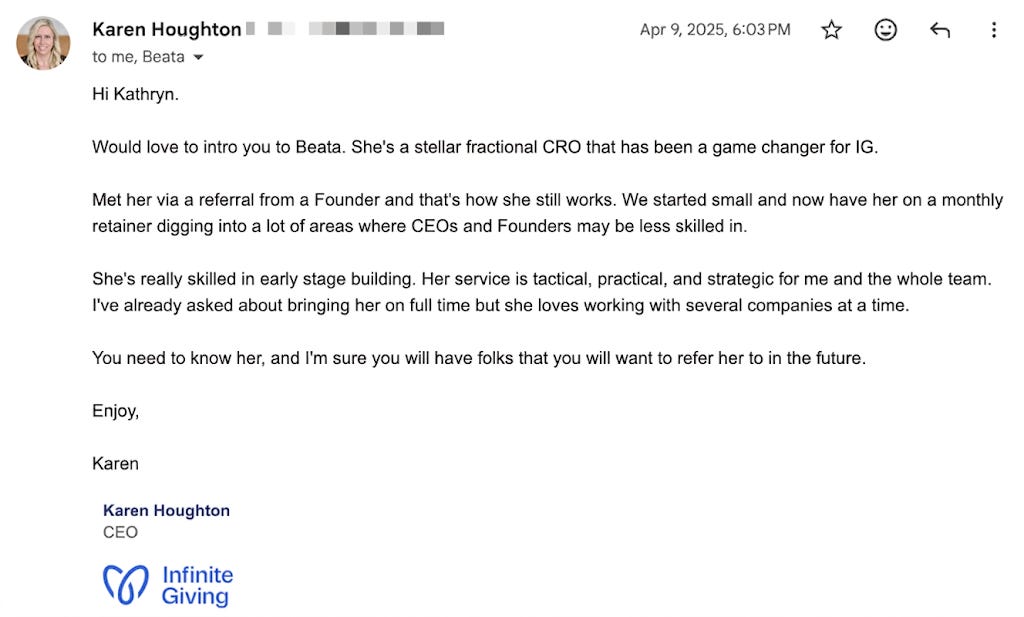
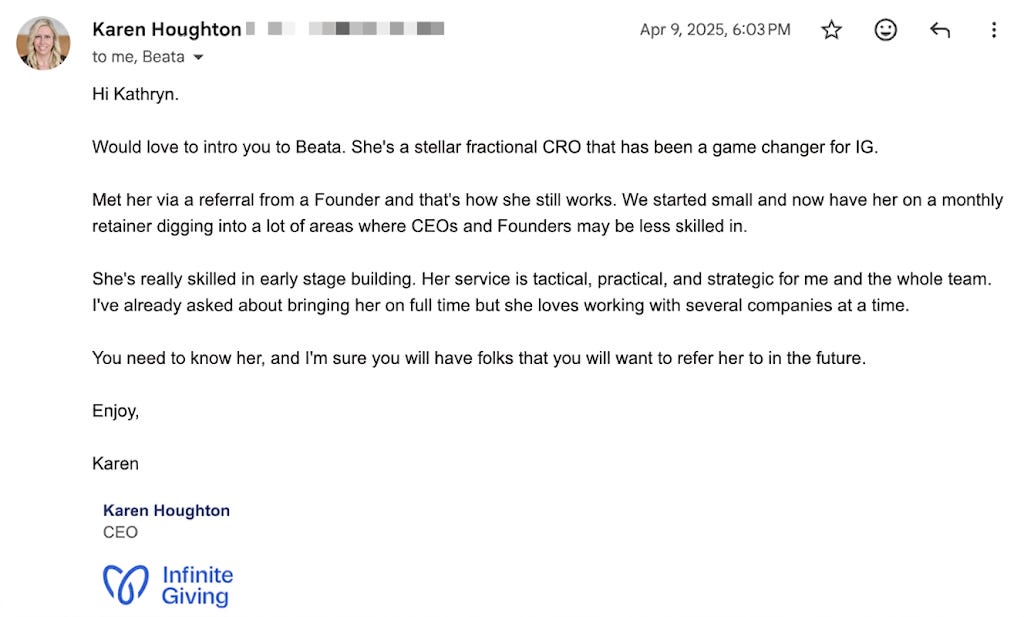
Ask the CEO to send an email recommendation on your behalf
This is the gold standard.
If a vendor or consultant comes to me, I say, help a portco and then I can recommend you to everyone!
This is how I knew that Beata Rouleau and Margaret Weniger were awesome.
Rave reviews from founders I know.
Startup Example: Pardot Implementation Partners
As Pardot grew exponentially, we had trusted partners who would do customer implementations.
How did they become trusted?
Because clients used them for other marketing consulting projects and told us they were great!
The best path to a great long-term partnership of any kind? Help customers!
2. Someone Who Knows Your Work Product
Until last month, I thought there was only one way in.
I LOVE BEING WRONG!
I shared my “intro from a portco” strategy and a founder told me that he was getting recommended by a PE firm without helping a portco first.
Whaaaaa? 🤯🤯🤯
“How did you get connected to the firm?”
“I worked with one of the partners at my previous company.”
BOOM. Duuuuuuh. Of course!
If you have worked with someone previously, they already know your personality, work quality, and impact.
Fantastic entry point!
It’s what I recommend to anyone first venturing out as a consultant:
Reach out to people you’ve worked with before.
No need for a perfect sales pitch. They know you.
Get some gigs through your contacts.
Now you have experience, happy customers, and a refined value prop!
Startup Example: Fundraising Strategy
This strategy applies to raising early capital too!
You might think that the wealthiest person you know (however distant) is the best option for a check, but you’re much more likely to raise from people who know you best.
I know founders who raised from college professors and church pastors.
The power of personal connection and lines over dots!
But, Kathryn, You Know I’m Awesome! Why Can’t You Recommend Me?
There are a lot of vendors and consultants that I really like and I’m sure they’d do a great job.
I know them through events, warm intros, or other trusted communities.
But I haven’t seen their work up close.
What if I referred a founder and the consultant did a bad job???
LITERALLY MY WORST NIGHTMARE 😱😱😱
Wasted money and time — because of me????— when startups are already tight on both.
Even if I know someone is great, it may not work out.
But at least I have a clear conscience on the leading indicators of the recommendation (aka I’ve seen their high quality work).
The other calculation I’m doing is time-to-verify.
I could do a deep dive reference check on every vendor —> hours of work.
Or I could read one glowing review email from a founder I trust —> minutes!
Are There Any Exceptions?
Always. 😉
1. The “Jane McCracken” Effect
When I was thinking of exceptions, I literally thought of Jane!
I haven’t worked directly with her but she’s built 3 companies and taken at least 2 of them public so, yea, she knows what she’s doing.
Sometimes people’s resume and personality are so good that you’ll recommend them no matter what!
2. Work On Display
Social media and brand building is an area where someone’s work is public.
Can they do it for your brand? Maybe, maybe not.
But you can see their work in real time so it’s easier to evaluate!
Ditto for outsourced sales, talent agencies, website design, etc.
3. Area of Expertise
The more direct experience I have with a job function, the easier it is for me to evaluate someone.
I’m much better at sniffing out Customer Success or COO competence than other roles.
4. Help a VC
If your service is relevant for the VC firm, you could help the firm as a way to showcase your value.
When Rebby John of Fastlane AI spent an hour talking to us about AI best practices, my mind was blown from the awesomeness.
(Fastlane AI is an Atlanta Ventures Studio Company so it was a different circumstance but I could see how it would work!)
Beware of spending too much time on anything where there’s not a fully paid engagement or deep pain point though…
You might end up with a disengaged or unimpressed VC firm which undermines the whole strategy!
Have you worked with any amazing consultants or vendors? What won you over? What’s your advice for vendors or consultants who want to “break into” startups or investing firms?